
Last time I built a two-transistor gate and proved it on the bench: the circuit grounds DATA MAIN pin 3 (PTTP) only when the FTDI cable’s RTS is asserted and DTR is released. I ended that post by promising to wire it into the software and take it on the air. This is that post.
Why a hardware line at all#
A quick recap, since the full story is in post 4 and post 6. The IC-910H keys fine over CI-V: send 1C 00 01 and it transmits. The problem is that keyed that way, the radio ignores the rear DATA-socket audio and puts out a silent carrier. Grounding PTTP is what selects DATA IN as the modulation source, so for APRS and for DATA-socket voice I need the physical pin pulled low, not a CI-V command.
The gate handles that. It keys only on RTS asserted AND DTR released, which means every accidental serial-port state (port closed, port opened by some other program, process killed, cable yanked) lands on a combination that does not key. That was the whole point of the hardware. Now the software has to drive it without ever stumbling into the keyed corner by accident.
The software design#
The new work is a --ptt rts-dtr mode in radio-ctl. A few decisions shaped it.
Every path that can key the radio already went through one method, Session.SetPTT:
- the TNC
- browser push-to-talk
- Hamlib clients over rigctld
- the REST API
I put the hardware keyer behind that method. The TX arbiter and its interlocks needed no changes, and none of the four paths knows anything is different.
After moving RTS, radio-ctl reads the radio back with 1C 00, a read and never a write. If the radio does not report PTT on within 250 ms, the line drops and the key fails loudly. A broken wire or a half-seated connector cannot pass as success. It is the difference between “I asserted a line and hope it worked” and “the radio says it is keyed”.
There are two independent locks. The rig layer refuses PTT without --allow-transmit. The serial port refuses to assert RTS unless it was opened for hardware PTT, and radio-ctl only does that when --allow-transmit is set. Both have to agree before a line moves.
radio-ctl also owns the port. Every open does three things:
- sets
TIOCEXCLso nobody else gets in - enables
HUPCLso the kernel drops the modem lines if the process dies - releases RTS and DTR immediately, so the gate starts idle
RTS itself is toggled with TIOCMBIS and TIOCMBIC.
Bench acceptance, radio still unplugged#
Before any antenna, I ran the real transport code against the scope with the radio disconnected. The jig is the same one I used for the gate validation. A 10 kOhm resistor to +5 V stands in for the radio’s PTT pull-up on DATA MAIN pin 3.
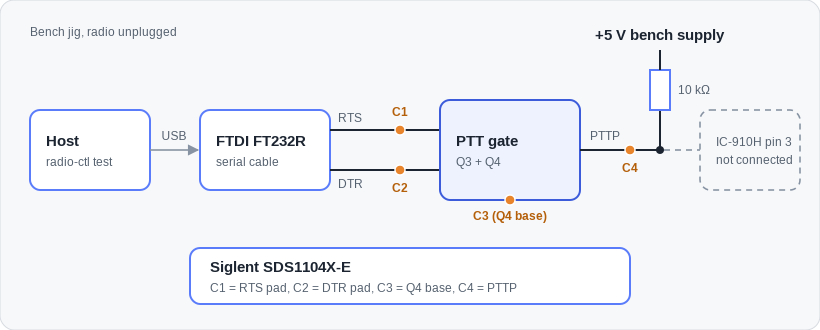
No CI-V frame is sent. The tests exercise only the transport layer, through a Go test behind the hardware build tag:
go test -c -tags hardware ./internal/transport
RADIOCTL_HW_PTT_DEVICE=/dev/ttyUSB0 ./transport.test
The test pauses at each step so a script can grab measurements, CSVs and screenshots.
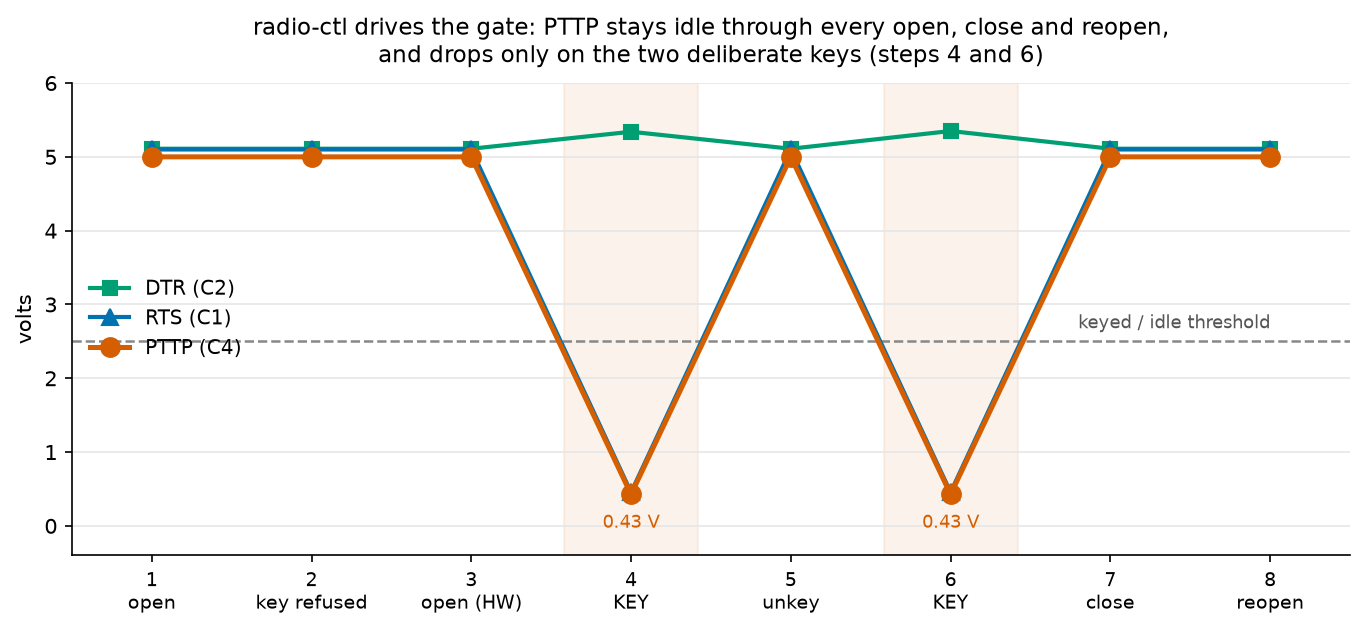
The sequence test (TestHardwarePTTSequence) walks PTTP through eight states:
| Step | Action | PTTP | Result |
|---|---|---|---|
| 1 | Open the port, HardwarePTT off | 5.00 V | idle |
| 2 | SetPTTLine(true), HardwarePTT off | 5.00 V | refused (ErrPTTLineDisabled) |
| 3 | Open the port, HardwarePTT on | 5.00 V | idle |
| 4 | SetPTTLine(true) | 0.427 V | keyed |
| 5 | SetPTTLine(false) | 5.00 V | unkeyed |
| 6 | SetPTTLine(true) | 0.427 V | keyed again |
| 7 | Close() while keyed | 5.00 V | unkeyed |
| 8 | Reopen in the same process | 5.00 V | idle |
At step 4 the other channels read RTS 0.45 V, DTR 5.34 V and Q4 base 1.15 V.
Step 2 matters most to me. Asking for the line without hardware PTT enabled gets a flat refusal, not a key.
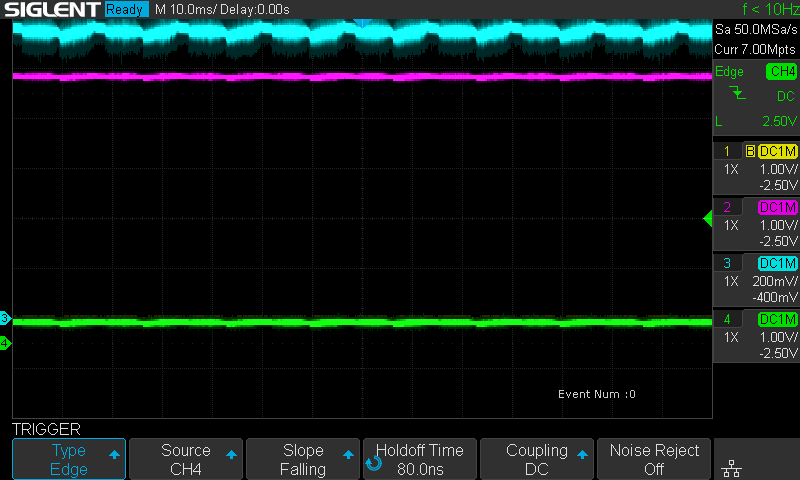
A note on those keyed readings. PTTP sits around 0.43 V in the keyed state rather than a dead 0 V, and so does RTS. That is a small common offset on every channel in this run, a measurement artifact, not the gate failing to pull down. The pull-down works; the whole stack of channels is shifted up by the same fraction of a volt.
The open/close test (TestHardwarePTTOpenClose) covers the risky moments, opening and closing the port. It runs 20 cycles of open, check-idle, close, with C4 armed on a falling edge at 2.5 V on normal trigger. If the port ever flickered through the keyed corner on its way up or down, the scope would latch that falling edge. Across all 20 cycles it never triggered, because an open only ever passes through “both asserted” and “both released”, never the keyed combination.
A clean pass on that armed test is a scope that never fires, so there is no waveform to show for it. The sharper picture comes from the sequence test’s own measurements. Plotting PTTP against RTS and DTR across all eight steps shows the shape of it: every open, close and reopen sits at 5 V, and PTTP only falls to 0.43 V on the two steps where radio-ctl asserts the line.
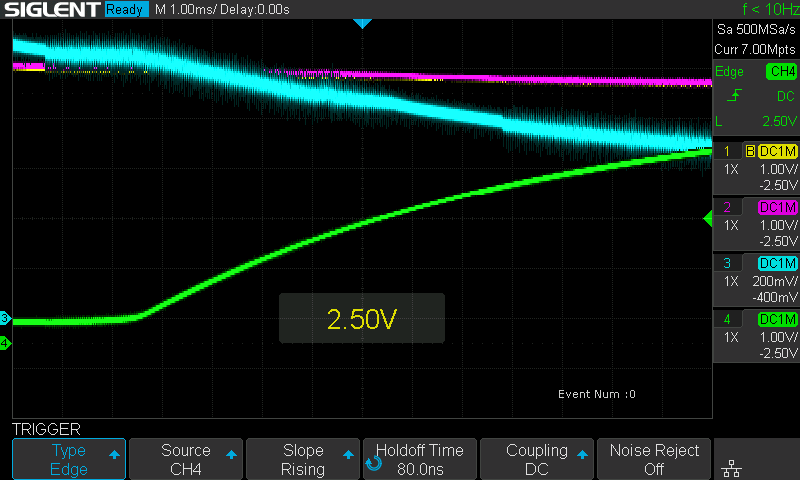
The crash test (TestHardwarePTTCrash) keys the line (PTTP 0.427 V) and then the test binary SIGKILLs itself, exit 137. PTTP went straight back to 5.00 V as the kernel released RTS and DTR. That is HUPCL doing its job: if radio-ctl dies mid-transmission, the transmitter unkeys on its own.
The port that would not close#
The first bench run did not get as far as those clean results. It failed at step 3. After Close(), reopening the port returned EBUSY, and the process holding it busy was radio-ctl itself.
The cause is a Go gotcha worth spelling out. Calling (*os.File).Fd() switches the file to blocking mode. My CI-V reader goroutine was parked in a blocking read(2) and holding the descriptor open, so Close() could not close the tty until a byte arrived. With no radio attached, none did.
The tty stayed open with TIOCEXCL still set, which locked out the reopen. Worse, HUPCL, my “release the lines when we die” safety net, cannot fire on a close that never happens.
The fix routes every ioctl through SyscallConn().Control(), which leaves the file non-blocking so Close() really closes. It also clears TIOCEXCL with TIOCNXCL on the way out. TestReopenAfterClose covers it now.
No unit test had caught this, because a pty does not behave like a real FTDI with a reader goroutine parked on it. The scope caught it.
One exception remains on purpose. The squelch reader still uses Fd(), because its blocking TIOCMIWAIT needs blocking mode. The TIOCNXCL on close covers that path too.
On the air#
Same day, operator present, into a dummy load first. The command:
./bin/radio-ctl --device /dev/ttyUSB0 --squelch hardware --allow-transmit --ptt rts-dtr --audio-capture hw:CARD=CODEC --audio-playback hw:CARD=CODEC
Every grant passed the CI-V 1C 00 read-back confirm. A failed confirm denies the lease, so nothing transmits unless the radio has already told radio-ctl it is keyed.
The log of the first good transmissions:
18:37:21 tx: granted owner=tnc kind=tnc
18:37:22 tx: released owner=tnc reason=released keyed_for=1.12s
18:37:26 direwolf: [0.4] VA7RCV-7>APY03D,ARISS,WIDE2-1::VA7RCV   :ack8
That last line is my own handheld acknowledging the APRS message radio-ctl sent. The AFSK made it out of the DATA socket and over the air, which CI-V keying could never have done. A second message came back ack9 after a 1.119 s key. Then I tried browser voice push-to-talk, which keyed and released seven times in a row, 283 to 945 ms each, all cleanly released.
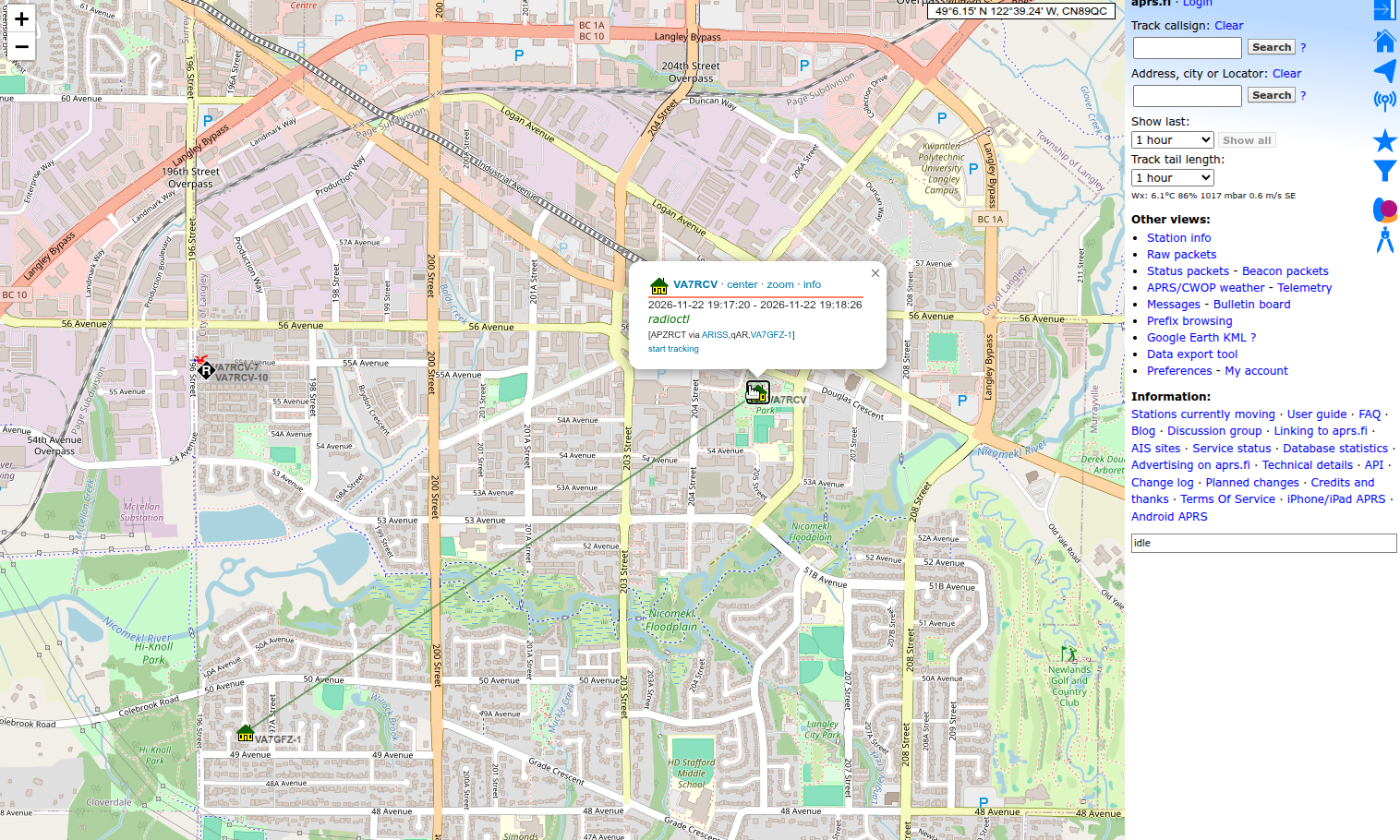
aprs.fi is the independent proof. The VA7RCV beacon radio-ctl transmitted (comment “radioctl”, path [APZRCT via ARISS,qAR,VA7GFZ-1], timestamp 2026-11-22 19:17:20, near Langley BC in grid CN89QC) reached the APRS-IS network through a gateway I do not control. Nothing in my own stack can fake that.
Thirty seconds of blank carrier#
An earlier attempt, at 18:31:58, had a typo in the command: --audio-playback hw:CARD=CODE, missing the final C. No sound card has that name, so the AFSK had nowhere to play. Direwolf’s frame never drained, and the “frame finished, unkey” step never happened.
The radio stayed keyed with nothing to send. It sat there as a blank carrier until radio-ctl’s 30-second transmit time-out cut it off.
The typo was not the real bug. The TX arbiter checked that a playback device was configured, but not that it was running. A bad device name should produce an error message, not half a minute of dead carrier on the air.
The arbiter now refuses to grant a transmit lease while the playback device is down, so a bad name fails before anything keys.
Browser audio that went silent#
This one was not a PTT bug, but it showed up while I was testing voice. Browser audio would sometimes be silent until I toggled “Listen” off and on. It looked tied to the microphone button, which sent me down the wrong path for a while.
I reproduced it in headless Chromium with Playwright, patching AudioContext.createMediaStreamSource to hang an analyser off every node the page built. Silent sessions measured -120 dB on both bands, and both bands’ WebAudio nodes were being fed the same MediaStream.
radio-ctl sends MAIN and SUB as two WebRTC tracks under a single stream id, so the browser handed the page one stream carrying both. The UI passed that stream to each band’s node, and createMediaStreamSource on a multi-track stream uses whichever track’s id sorts first. Those ids are random UUIDs, so about half the time both “bands” played SUB, which was squelched, and the audio came up silent. Every new session re-rolled the dice, which is why switching modes seemed to cause it.
The fix was one line: build new MediaStream([e.track]) per band so each node gets its own single-track stream. Before, 2 of 5 sessions came up silent. After, 10 of 10 had audio, with MAIN and SUB measurably independent. The cause was embarrassing and the fix was trivial, which is the usual ratio.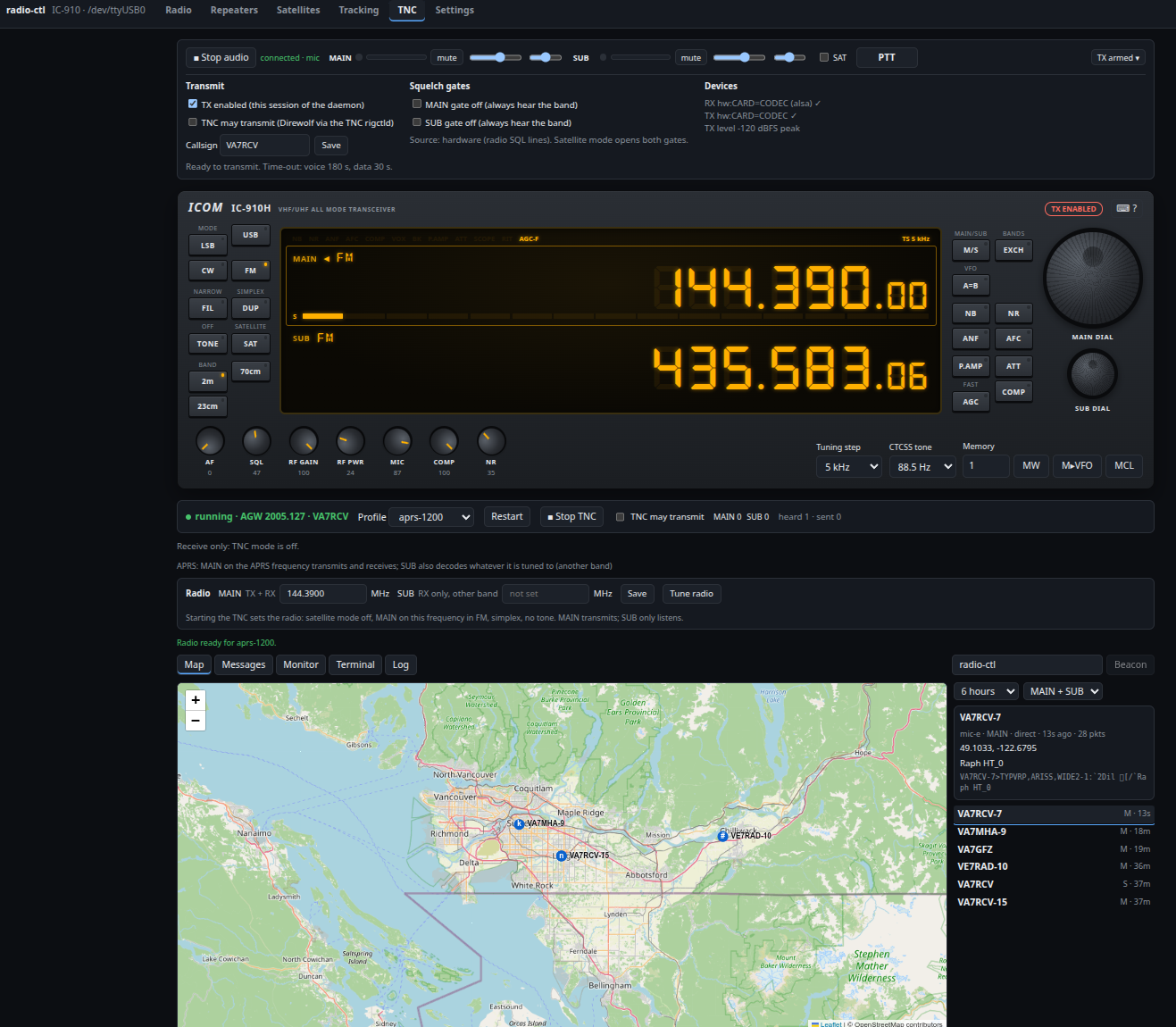
Next is a tour of the finished web console, which ties the TNC, the audio and this PTT path together.